
🔍 Overview
The Financial Risk Dashboard provides a consolidated, portfolio-level view to identify, assess, monitor, and mitigate financial risks across portfolios, programs, and projects.
It transforms financial risk management into a proactive and continuous discipline, enabling Finance teams and Executives to anticipate exposure, prioritize mitigation actions, and strengthen financial governance.
📌 Accessing the Financial Risk Dashboard
To access the dashboard:
Portfolio → Track → Financial Risk Dashboard
This dashboard operates at portfolio level, while consolidating financial risks originating from programs and projects.

📌 Explore the Financial Risk Dashboard Components
1️⃣Financial Risk Heatmap
The Financial Risk Heatmap visualizes financial risks based on their probability and impact, using a color-coded risk severity scale.
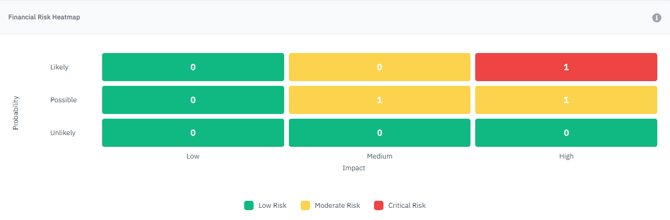
It enables you to:
-
Quickly identify high-exposure financial risks
-
Prioritize mitigation actions based on severity
-
Focus attention on critical risk areas with the highest potential financial impact
💡 This view provides an immediate snapshot of where financial exposure is most concentrated.
2️⃣Financial Risk Register
The Financial Risk Register provides a detailed list of all identified financial risks.
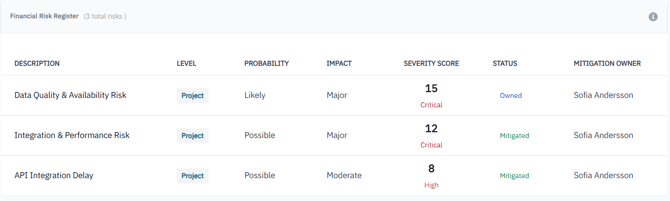
For each risk, it includes:
-
Risk description and type
-
Origin level (Portfolio, Program, Project)
-
Probability and impact
-
Financial exposure and severity score
-
Risk status (e.g. Owned, Mitigated)
-
Assigned mitigation owner
This register allows teams to:
-
Track and manage financial risks consistently
-
Assess potential financial exposure
-
Monitor mitigation status
-
Ensure clear accountability for risk ownership
3️⃣Financial Risk Trend
The Financial Risk Trend displays the evolution of financial risks over time, categorized as:
-
New risks
-
Resolved risks
-
Escalated risks
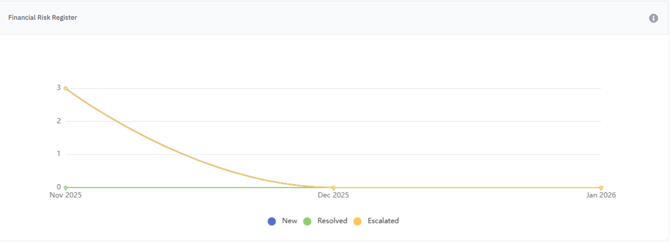
This view helps to:
-
Monitor financial risk dynamics
-
Determine whether overall financial exposure is increasing or decreasing
-
Evaluate the effectiveness of risk mitigation efforts over time
💡 Ideal for portfolio-level reviews and executive reporting.
4️⃣Mitigation Plan Tracker
The Mitigation Plan Tracker tracks the progress of mitigation plans for key financial risks.
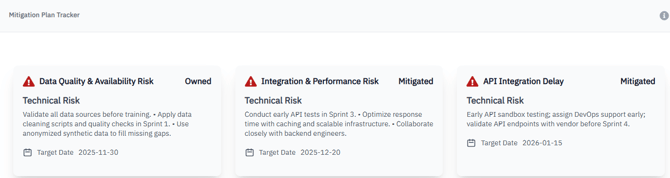
For each risk, it displays:
-
Defined mitigation actions
-
Target dates
-
Execution progress
-
Residual financial exposure
This view enables teams to:
-
Monitor mitigation execution in real time
-
Identify delayed or underperforming mitigation actions
-
Ensure accountability and follow-through for financial risk reduction
✅ Summary
The Financial Risk Dashboard enables organizations to:
-
Maintain continuous visibility on financial risk exposure
-
Detect critical risks early
-
Track mitigation execution and effectiveness
-
Strengthen financial governance and portfolio resilience